Magnolia acuminata, commonly called the cucumber tree, cucumber magnolia or blue magnolia, is one of the largest magnolias, and one of the cold-hardiest. The leaves of Magnolia acuminata are pointed at the tip and provide it with its name - 'acuminate' means tapering to a fine point. Magnolia acuminata is native primarily within the Appalachian belt.
尖頭玉蘭也叫漸尖木蘭,是最大的木蘭屬植物之一,也是最耐寒的木蘭屬植物之一。尖頭玉蘭的葉子頂端是尖的,因此得名。尖頭玉蘭主要原產於阿巴拉契亞山脈。
Notes for Magnolia acuminata 尖頭玉蘭筆記
- Magnolia acuminata, commonly called the cucumber tree, cucumber magnolia or blue magnolia, is one of the largest magnolias, and one of the cold-hardiest. It is a large forest tree of the Eastern United States and Southern Ontario in Canada.
- Magnolia acuminata is native primarily within the Appalachian belt, including the Allegheny Plateau and Cumberland Plateau, up to western Pennsylvania and New York.
- In Canada, Magnolia acuminata is listed as an endangered species and is protected under the Canadian Species at Risk Act. In 1993 The North American Native Plant Society purchased Shining Tree Woods to preserve a stand of Magnolia acuminata, which is also known as "The Shining Tree".
- Unlike most magnolias, the flowers are not showy. They are typically small, yellow-green, and borne high in the tree in April through June.
- The leaves of Magnolia acuminata are pointed at the tip and provide it with its name - 'acuminate' means tapering to a fine point. The name "cucumber tree" refers to the unripe fruit, which is green and often shaped like a small cucumber; the fruit matures to a dark red color and is 6–8 centimetres (2.4–3.1 in) long and 4 centimetres (1.6 in) broad, with the individual carpels splitting open to release the bright red seeds, 10–60 per fruit. The ripe fruit is a striking reddish orange color.
- Magnolia acuminata are excellent shade trees for parks and gardens, though they are not recommended for use as street trees.
- It has been marked as a pollinator plant, supporting and attracting bees and butterflies. It is a host plant for butterflies, providing food during their larval stage.
- 尖頭玉蘭也叫漸尖木蘭,俗稱黃瓜樹、黃瓜木蘭或藍木蘭,是最大的木蘭屬植物之一,也是最耐寒的木蘭屬植物之一。它是美國東部和加拿大安大略省南部的大型森林樹種。
- 尖頭玉蘭主要原產於阿巴拉契亞山脈,包括阿勒格尼高原和坎伯蘭高原,直至賓州西部和紐約州。
- 在加拿大,尖頭玉蘭被列為瀕危物種,受到加拿大《瀕危物種法》的保護。1993 年,北美本土植物協會購買了閃亮樹林,以保護一片尖葉木蘭林,這種木蘭也被稱為「閃亮之樹」。
- 與大多數木蘭不同,這種花並不艷麗。它們通常很小,黃綠色,四月到六月生長在樹上高處。
- 尖頭玉蘭的葉子頂端是尖的,因此得名。「尖頭」的意思是一端逐漸變細。「黃瓜樹」這個名字指的是未成熟的果實,它是綠色的,通常形狀像小黃瓜;果實成熟時呈深紅色,長 6-8 公分(2.4-3.1 英吋),寬 4 公分(1.6 英吋),單一心皮裂開,釋放出鮮紅色的種子,每個果實有 10-60 顆。成熟的果實呈現引人注目的紅橙色。
- 尖頭玉蘭是公園和花園的絕佳遮蔭樹,但不建議用作行道樹。
- 它被標記為傳粉植物,支持和吸引蜜蜂和蝴蝶。它是蝴蝶的寄主植物,為蝴蝶的幼蟲階段提供食物。
Here are some varieties and hybrids derived from the Magnolia acuminata:
以下是由尖頭玉蘭衍生的一些變種及雜交品種:


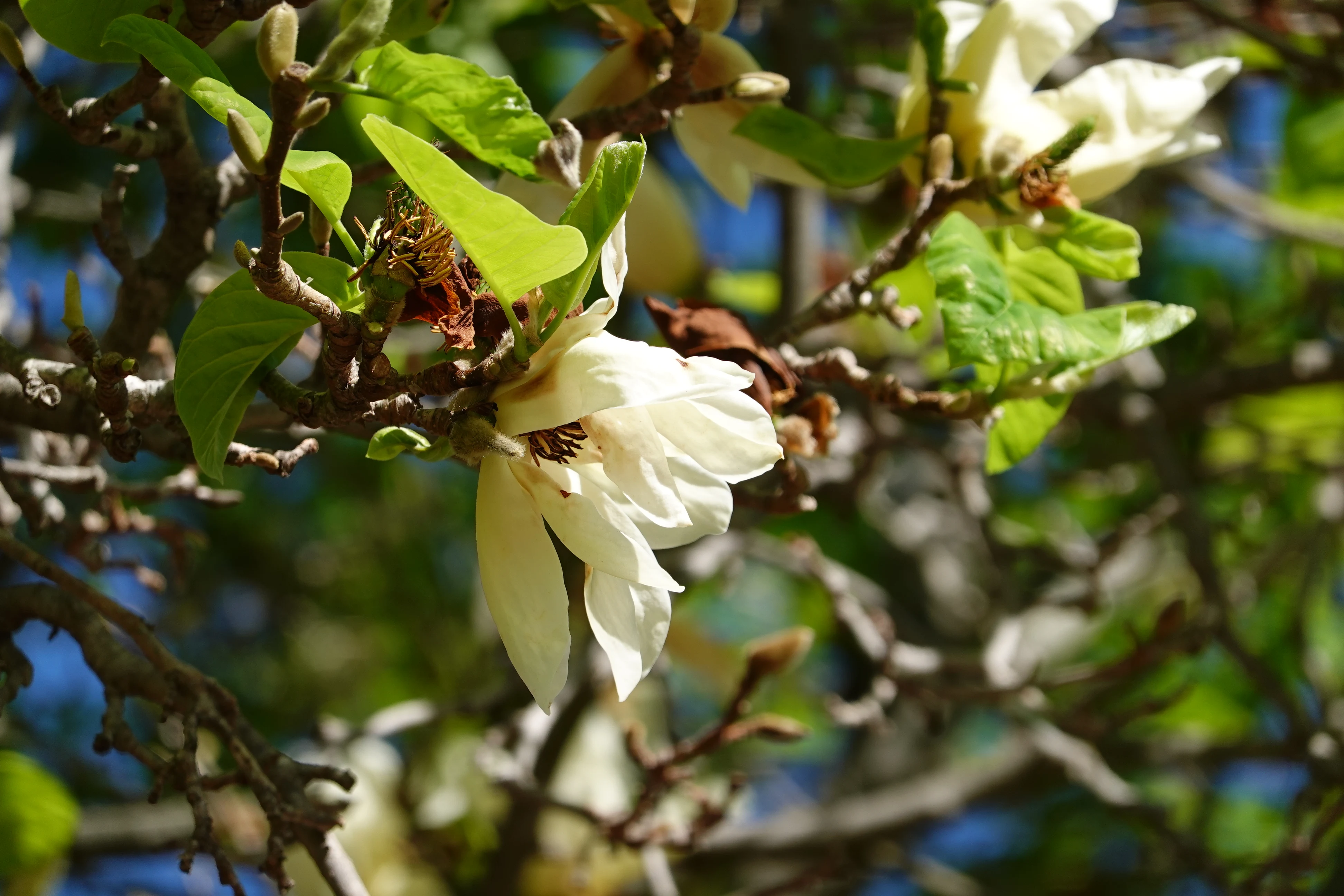
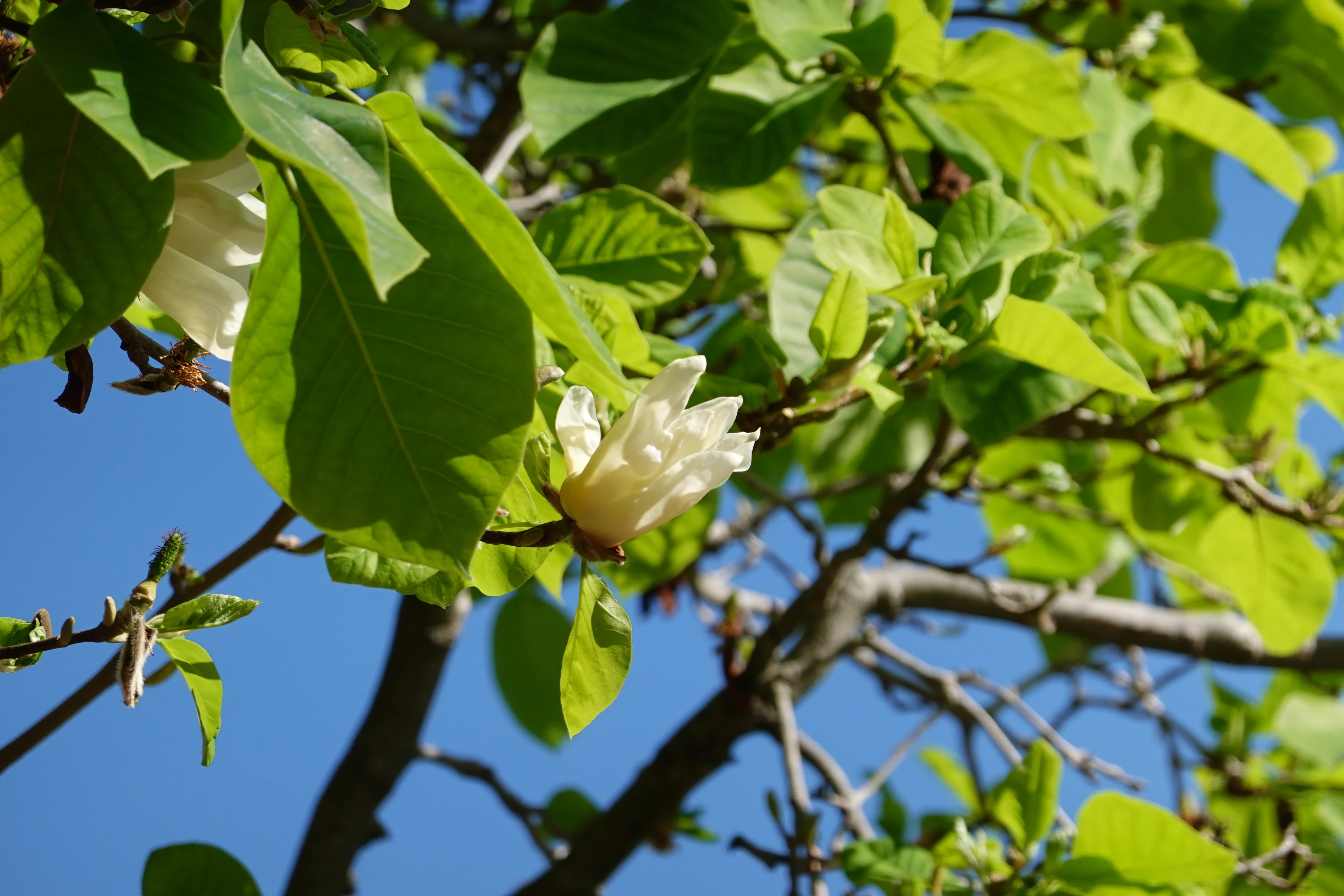

Notes for Magnolia ‘Elizabeth’ 伊莉莎白玉蘭筆記
- Magnolia ‘Elizabeth’ is a hybrid Magnolia that is the offspring of a cross between Magnolia denudata (Yulan magnolia) and Magnolia acuminata (cucumbertree).
- It is the result of a breeding program to create yellow-flowered varieties conducted at the Brooklyn Botanic Garden beginning in 1953.
- Masses of large, cup-shaped, primrose yellow flowers appeared in early to mid-spring at the twig tips. Slightly fragrant. The large blooms may last up to 4 weeks. This cream to pale yellow flowered Magnolia ‘Elizabeth’ gained the Royal Horticultural Society’s Award of Garden Merit in 1993.
- It is named for Elizabeth Van Brunt, who donated funds to the Brooklyn Botanic Garden.
- 伊莉莎白玉蘭是一種雜交木蘭,由玉蘭與尖頭木蘭(又稱黃瓜樹)雜交培育而成。
- 這是布魯克林植物園自 1953 年起開展的一項旨在培育黃花品種的育種計畫的成果。
- 春季的早期到中期,枝梢上會綻放出大量碩大、杯狀的淺櫻草黃色花朵,並散發出淡淡幽香。這些碩大的花朵花期可長達四周。這款花色呈乳白至淺黃色的伊莉莎白玉蘭於 1993 年榮獲英國皇家園藝學會頒發的「花園優異獎」。
- 它以伊麗莎白·範·布倫特(Elizabeth Van Brunt)的名字命名,她曾向布魯克林植物園捐贈資金。


Notes for Magnolia ‘Ivory Chalice’ 象牙聖杯玉蘭筆記
- ‘Ivory Chalice’ is a cross between Magnolia denudata and Magnolia acuminata.
- ‘Ivory Chalice’ has gorgeous, upright, chalice-shaped, ivory flowers in late winter or early spring. Fragrant.
- A magnolia hybridized by the late David G. Leach of Madison, Ohio.
- 「象牙聖杯」是玉蘭與尖頭木蘭(Magnolia acuminata)的雜交品種。
- 「象牙聖杯」在冬末或早春開出華麗、直立、呈聖杯狀的象牙色花朵,並散發芬芳。
- 由俄亥俄州麥迪遜市已故的大衛·G·利奇(David G. Leach)培育的雜交木蘭。


Notes for Magnolia ‘Yellow Bird’ 黃鳥玉蘭筆記
- It is a hybrid Magnolia resulting from a cross between Magnolia x brooklynensis ‘Evamaria’ and Magnolia acuminata.
- Yellow Bird was developed by Doris Stone of the Brooklyn Botanic Garden and introduced in 1981.
- This is an upright, conical to pyramidal, deciduous, yellow-flowered hybrid magnolia that will mature over time to 40’ tall.
- Goblet-shaped, yellow flowers (to 3”) bloom in spring as the new leaves emerge.
- 這是一種雜交木蘭,由布魯克林木蘭 ‘Evamaria’ 品種與尖頭木蘭(Magnolia acuminata)雜交培育而成。
- 「黃鳥」由布魯克林植物園的多麗絲·斯通(Doris Stone)培育,於 1981 年推出。
- 這是一種直立、呈圓錐形至稜錐形的落葉雜交木蘭,開黃花,成熟後株高可達 40 英尺
- 春季新葉萌發時,會開出高腳杯狀的黃色花朵(可達 3 吋)。
References 參考資料
- Wikipedia: Magnolia acuminata
- Wikipedia: Magnolia 'Elizabeth'
- The Dawes Arboretum: Magnolia 'Ivory Chalice'
- Caerhays Estate: History and breeding of yellow Magnolias
Posts: Plants by Name 植物-英文名錄
Posts: Plants by Order/Family 植物-目/科錄